
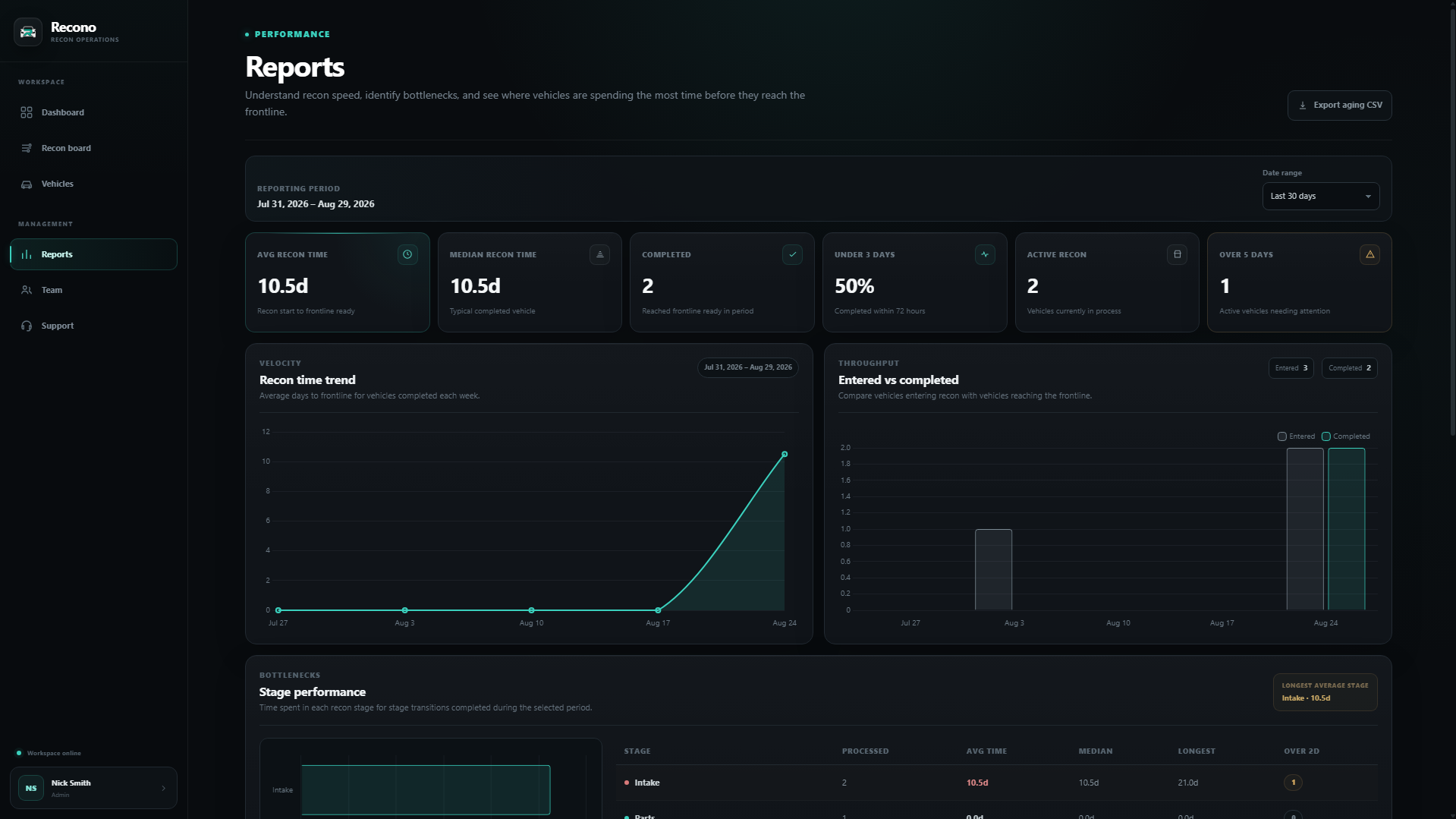
Average recon time
The mean elapsed recon time across completed vehicles. Useful for trend direction, but sensitive to extreme outliers.
Time-to-Line, often shortened to T2L, measures the elapsed time from a dealership's chosen recon start point to the moment a vehicle is ready for the frontline. The useful part is not just the final number; it is knowing which stages consumed the time.
Time-to-Line (T2L) is the elapsed time it takes a dealership to move a vehicle from acquisition or recon intake to frontline-ready status. Dealers use T2L to measure reconditioning speed, while stage-level dwell time helps explain where delays occurred inside the process.
Time-to-Line = Frontline-ready timestamp - recon start timestamp.
The important part is defining the start and end points consistently. Some stores measure from acquisition, while others use arrival or recon intake. Whichever definition a dealership chooses, every vehicle should be measured the same way so the trend remains comparable.
For management, the average is useful, but the median can be equally important because a handful of extreme outliers can distort the average. Stage-level time is what turns the top-line T2L number into something actionable.
There is no universal SLA for every vehicle mix, but industry writing frequently uses a three-to-five-day T2L as a strong operating target for used-vehicle recon.
WardsAuto reported that dealers consistently achieving strong recon performance had reached three-to-five-day time-to-line results. Vehicle age, condition, parts availability, sublet work, certification requirements, staffing, and store process can all change what is realistic for a specific unit.
Source context: WardsAuto, “Getting More Out of Used-Car Reconditioning”. Recono does not treat 3-5 days as a universal guarantee or requirement.
The mean elapsed recon time across completed vehicles. Useful for trend direction, but sensitive to extreme outliers.
The middle result after completed vehicles are sorted by recon time. Helpful for understanding the typical vehicle.
How long vehicles spend in inspection, service, parts, detail, photos, or other stages. This helps explain the total T2L.
How many active units are beyond the dealership's target. This turns T2L from a historical report into a daily operating queue.
Long recon time is often the accumulation of small waits rather than one dramatic failure. A vehicle can be physically untouched for hours or days between otherwise short tasks.
WardsAuto's published analysis of 66 dealerships also found that detail time was a major differentiator between slower and faster T2L stores, reinforcing why stage-level measurement matters.
Recono records vehicle movement through the recon board and turns that history into average and median recon time, throughput, aging, and stage-performance reporting.
Concise answers to common dealership reconditioning questions related to this topic.
T2L stands for Time-to-Line. In dealership reconditioning, it describes the elapsed time required to move a vehicle from the dealership's defined recon start point to frontline-ready status.
A dealership can define the start at acquisition, arrival, or recon intake. The most important requirement is consistency so every vehicle and reporting period is measured from the same operational event.
No. Three to five days is a commonly cited industry benchmark, but the appropriate target depends on vehicle condition, certification requirements, parts, vendors, staffing, and the dealership's own workflow.
Median recon time shows the middle completed vehicle and is less affected by a few extreme outliers. Looking at both average and median gives managers a more complete view.
Stage dwell time is the amount of elapsed time a vehicle spends in a specific recon stage. It helps identify where the total Time-to-Line is accumulating.
Recono tracks vehicle movement through recon stages and reports average recon time, median recon time, active aging, throughput, and stage performance so managers can connect total T2L to specific bottlenecks.
Start with a few live vehicles and give your rooftop a shared view of the reconditioning process.