
Average and median recon time
Track how long completed vehicles are taking overall and compare the mean with the typical middle result.
A single average can tell you recon is slow. It cannot tell you why. Recono combines overall recon time with throughput, active aging, and stage-level performance so managers can see where vehicles are losing time.
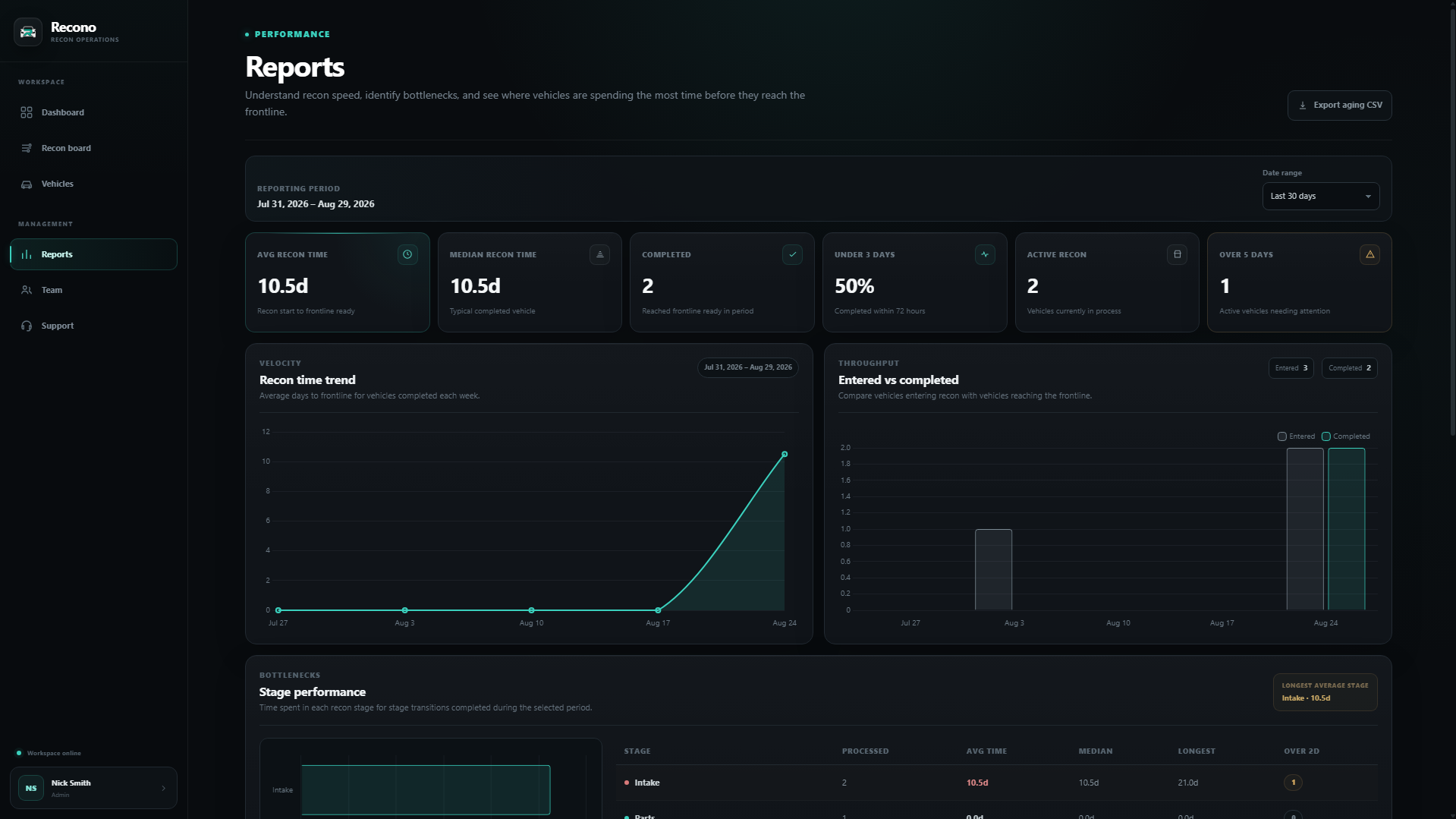
Dealership recon reporting should measure overall recon time, median recon time, active vehicle aging, completed-vehicle throughput, vehicles entering versus completing recon, and time spent in individual stages. Together, those metrics show both the result and the bottlenecks that created it.
Track how long completed vehicles are taking overall and compare the mean with the typical middle result.
Compare new recon entries with frontline completions to see whether the pipeline is expanding or clearing.
Measure time spent inside the stages that make up the total recon cycle.
An average is a useful summary, but it can hide different operational realities. Two stores can have the same average while one has a consistent process and the other has many fast vehicles plus a handful of severe outliers.
| Metric | What it tells you | What it can miss by itself |
|---|---|---|
| Average recon time | Overall mean cycle time | Can be pulled by a few extreme vehicles |
| Median recon time | Typical middle completed vehicle | Does not show the size of the oldest tail |
| Active aging | Current units already sitting too long | Does not show where the time accumulated |
| Stage dwell | Where waiting/work time exists | Needs overall context to understand total impact |
| Throughput | Whether completions keep pace with entries | Does not explain why specific units are delayed |
“Why is detail averaging longer this month?” is more actionable than simply knowing the total recon average increased.
Concise answers to common dealership reconditioning questions related to this topic.
Recono reports on average and median recon time, completed vehicles, active recon, aging inventory, entered-versus-completed throughput, and time spent in individual recon stages.
Median recon time is less sensitive to a small number of extreme outliers and can provide a useful view of the typical completed vehicle when used alongside the average.
Stage performance measures how much time vehicles spend in specific workflow stages, helping managers identify where total recon time is accumulating.
It compares the number of vehicles entering recon with the number reaching completion during a period. If entries consistently exceed completions, the active pipeline may be growing.
Yes. Active aging identifies current vehicles that need attention, while stage timing helps show whether a repeated handoff or stage is contributing to delays.
Stage history is what allows a recon system to measure how long vehicles spent in different parts of the process, which makes bottleneck reporting more useful.
Start with a few live vehicles and give your rooftop a shared view of the reconditioning process.