
Clear entry criteria
Everyone should know what must be true before a vehicle enters a stage.
A strong used-car reconditioning process is a visible sequence of ownership changes. Every stage should answer what work is happening, who owns the vehicle now, what completion means, and where the unit goes next.
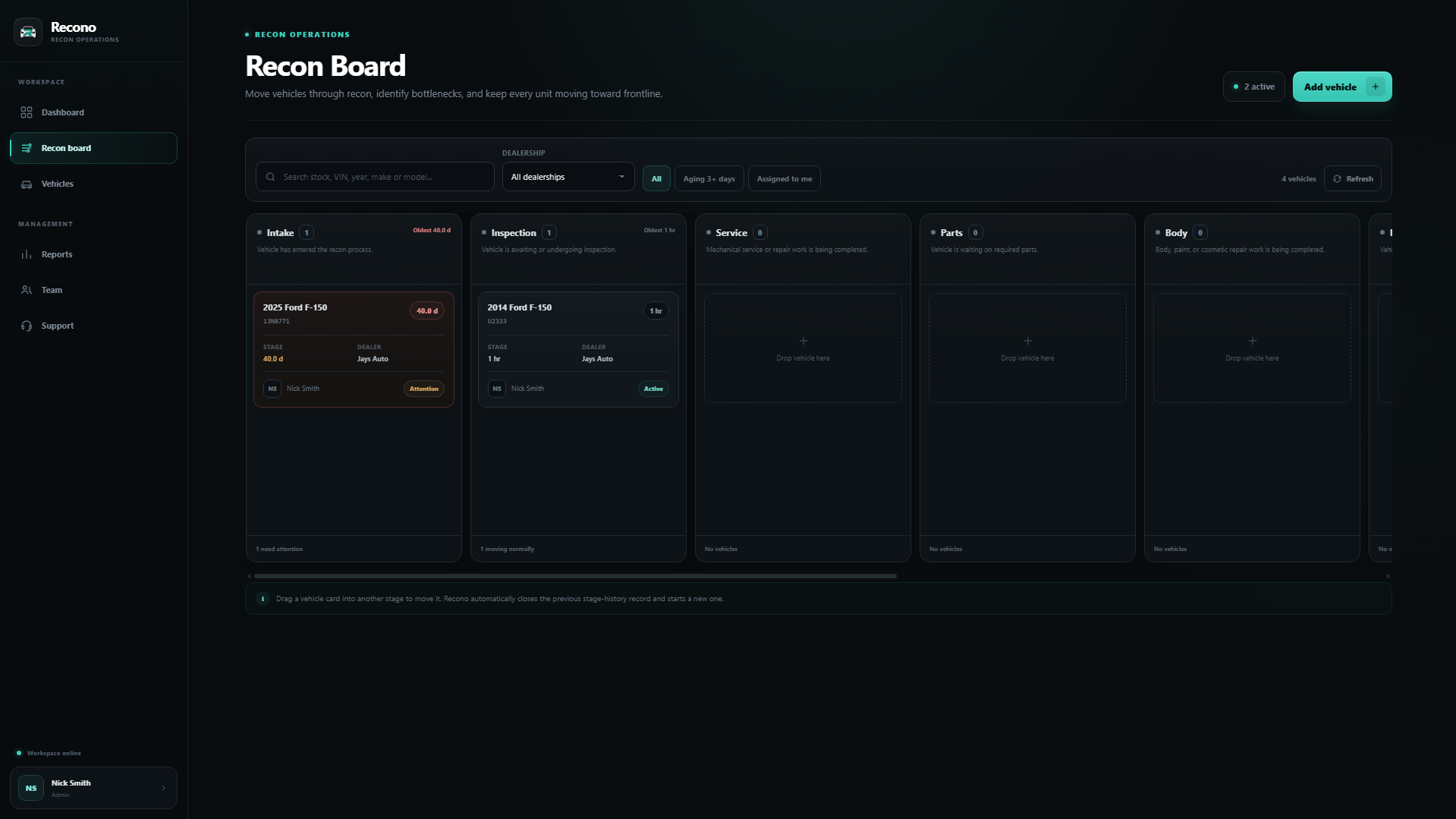
A dealership recon process is the sequence used to move an acquired or traded vehicle from intake to retail-ready inventory. It commonly includes inspection, approval, mechanical repair, parts or sublet work, cosmetic work, detail, photos, and a final frontline handoff.
The workflow should represent real changes in responsibility. A stage exists because someone needs to know a vehicle is waiting for a specific type of work or decision.
Everyone should know what must be true before a vehicle enters a stage.
Each active stage should have a person or team responsible for moving the unit forward.
A stage should end when a defined piece of work or decision is complete, not when someone remembers to update a list.
No two rooftops need exactly the same stage names, but the following structure covers the major operational handoffs found in many used-vehicle reconditioning processes.
Industry context: WardsAuto has published a similar best-practice stage sequence, including purchase/auction, inspection, approval, service repair, parts hold, sublet/body, detail, photos, and sale-ready status. Read the WardsAuto article.
Use enough stages to expose meaningful handoffs and bottlenecks, but not so many that updating the board becomes work of its own. If two stages always have the same owner, happen together, and do not produce useful separate timing data, they may not need to be separate.
Ask: “If this vehicle sits here for two days, would knowing that change what a manager does?” If the answer is yes, the stage is probably operationally meaningful.
A repair may take an hour while the vehicle waits a day for approval, a day for a part, and another day before detail knows it is ready. The process should make waiting states visible.
Inspection, mechanical repair, body work, detail, or photos are actively progressing.
Approval, parts, vendor availability, transportation, or another dependency prevents the next action.
If a vehicle is waiting on parts or a decision, that distinction matters because the corrective action is different from a technician actively working on it.
| Metric | Question it answers | How to use it |
|---|---|---|
| Time-to-Line | How long does the whole recon cycle take? | Track overall speed and trend direction. |
| Stage dwell | Where is the time accumulating? | Find bottlenecks and waiting states. |
| Active aging | Which vehicles need attention right now? | Create a daily exception queue. |
| Throughput | Are completions keeping pace with new entries? | Understand whether the pipeline is growing or clearing. |
| Average + median | What is the overall result and the typical result? | Separate broad trends from outlier distortion. |
Recono turns the rooftop's existing recon stages into a live board. Vehicles move from stage to stage, stage history is retained, aging becomes visible, and reports summarize the time created by those handoffs. The goal is not to add a new process layer; it is to make the current process measurable and easier to manage.
Concise answers to common dealership reconditioning questions related to this topic.
Common stages include acquisition or intake, inspection, approval, mechanical service, parts hold, body or sublet work, detail, photos or merchandising, and frontline-ready status. Stores should adapt the stages to their actual operation.
If parts delays are frequent enough to affect vehicle aging, a separate parts-hold stage can make the waiting time and ownership more visible than leaving the vehicle inside a generic service stage.
Ownership varies by store, but the process needs a clearly accountable manager or coordinator with authority to surface aging units, resolve handoff issues, and keep departments aligned.
The useful standard is whenever responsibility or work status meaningfully changes. A system that is updated only at the end of the day will be less useful for managing active bottlenecks.
A stage represents a major state or ownership handoff in the vehicle's journey. A task is a specific action that may happen within a stage. Keeping that distinction prevents the workflow from becoming unnecessarily complex.
Recono is stage-based and is intended to represent the steps a rooftop already uses, allowing the store to create visibility without replacing its underlying recon process.
Start with a few live vehicles and give your rooftop a shared view of the reconditioning process.